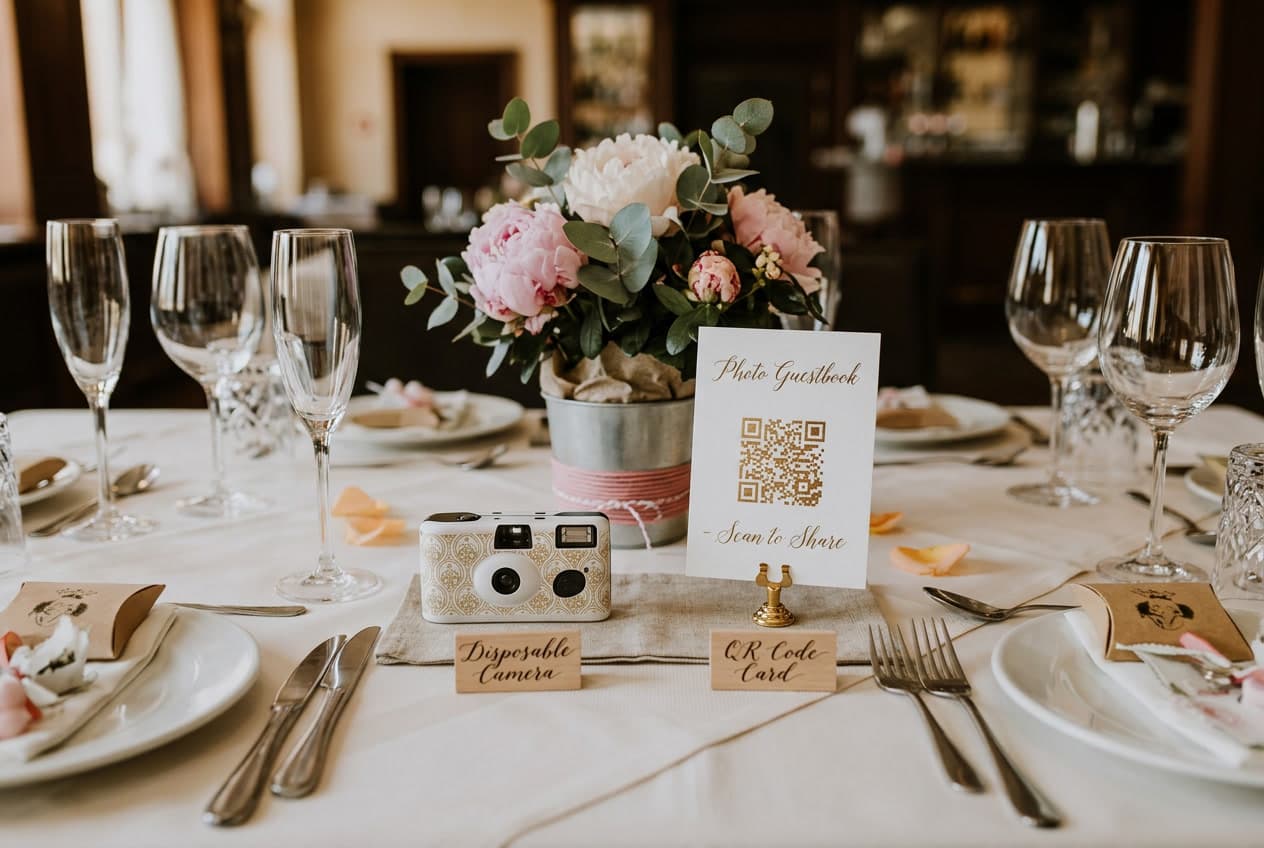
Disposable cameras at weddings refuse to die. Every few years they cycle back into the Pinterest boards, brides buy them in bulk, scatter them on tables, and then spend $150+ getting the film developed only to find that 40% of the photos are blurry, overexposed, or someone's thumb.
We're not here to kill the nostalgia — disposable cameras are genuinely fun. But if your goal is to actually collect usable guest photos, the math doesn't work. A QR code for wedding pictures does the same job for a fraction of the cost, delivers instantly, and every photo is sharp.
Here's the honest side-by-side.
The Cost Comparison
Let's do the real math for a 150-person wedding with 15 tables.
Disposable Cameras
- Cameras: 15-20 cameras × $15-25 each = $225-500
- Film developing: 15-20 rolls × $10-18 each = $150-360
- Digital scans: Some labs charge extra = $0-150
- Total: $375-1,010
- Turnaround: 1-3 weeks to get photos back
- Usable photos: Maybe 50-60% are in focus and properly exposed
Wedding QR Code
- Platform fee: $19-49 for unlimited uploads
- Printing cards: $5-15 at any print shop (or free if you print at home)
- Total: $24-64
- Turnaround: Instant — photos appear in your album as guests upload
- Usable photos: 95%+ (modern phone cameras are remarkably good)
That's a 6-15x cost difference for more photos, faster delivery, and higher quality. The economics aren't close.
What You Actually Get the Morning After
This is where the comparison gets real.
With disposable cameras
You pack up 15-20 cameras, hope none got stolen or dropped in the punch bowl, ship them to a lab, wait 1-3 weeks, and open a envelope of prints. Some are magical — that slightly overexposed, grainy charm that digital can't replicate. Many are unusable. A few are just... dark. The flash didn't fire, someone was too far away, or the lens had a fingerprint on it.
You'll get roughly 300-400 exposures total. After removing the bad ones, maybe 150-200 usable shots.
With a QR code
You wake up the next morning, open your phone, and there are already photos in your album. By the time you land at your honeymoon destination, you might have 200-500 photos and dozens of videos — all full resolution, all from your guests' actual phones, all instantly downloadable.
Our platform data shows that Saturday weddings (which make up nearly 60% of all events on WeddingSnap) see the highest volume of guest uploads, with the biggest surge happening between 9pm and midnight — exactly the moments your photographer has already packed up.
The Quality Question
Here's where disposable camera fans push back: "But the film aesthetic is the whole point."
Fair. There's something about the grain, the warm tones, the slight blur of a disposable that feels romantic and nostalgic. If that aesthetic is what you're after, and you're okay with the cost and the wait, disposable cameras deliver a vibe that digital can't fully replicate.
But consider this: your guests' phones shoot at 12-48 megapixels. A disposable camera shoots at roughly 4-5 megapixels equivalent. If you ever want to print a guest photo larger than 4×6, the disposable version falls apart. The phone version looks great at 16×20.
And here's the thing nobody talks about — you can apply film-look filters to digital photos in 2 seconds. You can't add sharpness to a blurry film exposure.
The Participation Problem
Disposable cameras have a hidden failure mode: not every guest uses them.
A camera sitting on a table requires someone to:
- Notice it
- Pick it up
- Figure out the viewfinder and flash
- Take photos (limited to 27 exposures per camera)
- Put it back
In practice, one or two enthusiastic guests at each table use the camera, and most of the others don't touch it. You end up with photos from maybe 15-30% of your guests.
A QR code has a completely different dynamic. Everyone already has their phone out. Scanning takes 3 seconds. There's no limit on how many photos they can upload. And if your DJ mentions it once, participation more than doubles compared to letting the cards sit silently.
Can You Do Both?
Absolutely — and honestly, this might be the best answer for couples who love the disposable aesthetic but also want complete coverage.
Put disposable cameras on a few feature tables (the bridal party table, the family tables) for that nostalgic charm. Put QR code cards on every table for broad coverage. You get the film look from your closest people and the volume from everyone else.
The disposable cameras become a fun activity. The QR code does the actual collecting.
The Verdict
If you want nostalgia and aesthetic above all else, and you're okay spending $400-1,000 and waiting weeks for mostly-usable photos: disposable cameras.
If you want every candid moment from every guest, instantly, in full resolution, for under $50: a wedding QR code.
If you're smart about it: both. Use the cameras for charm and the QR code for coverage.
We've built WeddingSnap to be the easiest QR code option out there — set it up in 2 minutes and your guests handle the rest. Or compare your options in our honest comparison of wedding photo sharing apps.
For more wedding QR code ideas including I Spy games and creative sign designs, we've got you covered.
Browse free QR code sign templates → print, customize, done.