Wedding Audio Guest Books: How They Work + Message Ideas
WeddingSnap Team
6/16/2026
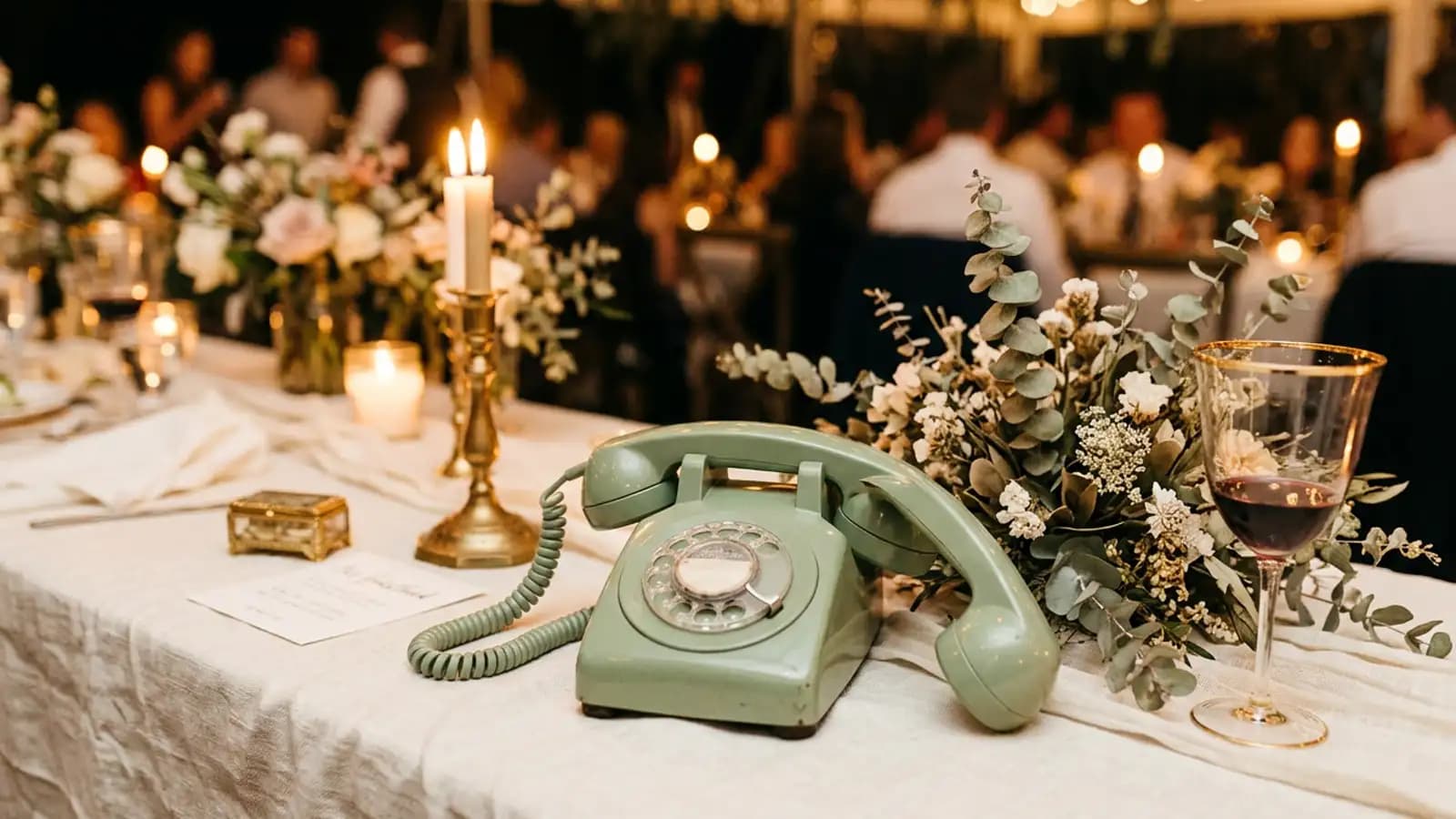
Full disclosure: we include an audio guestbook in our $39.99 wedding gallery. That gives us an obvious interest in telling you not to rent a vintage phone. We are not going to do that, because a rented phone gives you something we cannot, and if that thing is what you want then $375 is a reasonable price for it. What follows is an honest comparison of five ways to do this, with every price read from the company's own site on October 7, 2026.
The short version of the decision: a rental sells you an object at your reception. An app sells you the recordings. Almost every couple who regrets their choice got that distinction wrong in one direction or the other.
The short answer
- Best if you want the phone itself: a vintage phone rental, roughly $249 to $400 from the companies we checked. The handset is a piece of decor, a conversation starter and a photograph. That is most of what you are paying for, and it is a real thing to want.
- Cheapest if voice is all you want: a QR or virtual-number service. JoinMyMoment charges $19.99 for up to 100 guests; After The Tone's virtual guestbook is $79. No hardware, no shipping, no object.
- Best if you also want guest photos: a gallery that includes voice messages. Ours is $39.99 once for photos, video, voice messages, a live slideshow and printable signage together — less than the cheapest rental for the whole set.
- Best if you want to keep the phone: buy and convert one. A second-hand rotary phone plus a conversion kit lands in similar territory to a rental, and you own it afterwards.
- The question that decides it: at the end of the night, are you keeping a prop or a folder of recordings? If it is the prop, rent or buy. If it is the recordings, do not pay hundreds of dollars for a handset.
What an audio guest book actually is
Instead of signing a book, guests leave a short voice message. You get back a set of audio files: your grandmother's voice, your best friend at 11pm, your uncle being funnier than he has ever been.
It is also the busiest time of year to be deciding this. October is now the single biggest month on our platform — about one event in six — so if you are reading this in autumn, every rental company's calendar is tighter than it looks.
Couples who have one almost always say it is the thing they go back to. A signed book gets opened once. The recordings get played, and they carry a voice, which a line of handwriting does not. It is, in our fairly biased view, the most underrated item on a wedding checklist.
There are three distinct ways the recording can happen, and the price gap between them is enormous:
- A physical handset at the reception. A converted vintage phone that records when you lift the receiver.
- A phone number guests call. They dial, hear your greeting, leave a message.
- A browser page guests open. Usually from a QR code; they tap record and speak.
All three produce audio files. The first costs several hundred dollars and puts an object on a table. The third often costs nothing extra if you are already collecting photos.
What actually matters when choosing
1. Whether you want an object. This is the honest crux. A brass-and-bakelite phone on a linen table is a design decision, and it photographs. If you have a styled reception and you want that in the pictures, no app substitutes for it.
2. The rental window. Rentals are time-boxed — one company we checked includes a 24-hour window as standard. This matters more than it used to. On our own platform, Saturday is still the dominant wedding day at more than six in ten events, but Friday and Sunday together now account for nearly a quarter — and a Friday or Sunday wedding almost always means a weekend, not a day. If your celebration spans a rehearsal dinner, a ceremony and a brunch, price the multi-day window before you compare headline rates, because that is where a $249 starting price becomes a different number.
3. What happens after the phone goes back. This is the argument we find most persuasive and we have not seen a rental company address it. Across our galleries, only about six in ten uploads arrive during the event or the morning after; roughly three in ten land between two days and a week later. A rented handset is boxed up and shipped back before most of that window has even opened. Whatever a guest thinks of on the drive home, or remembers on Tuesday, has nowhere to go.
4. Shipping and returns. Both companies we checked include nationwide shipping, which is not universal. A rental that does not include return shipping is not the price on the page, and there is usually a damage deposit.
5. How you get the files. Rentals mail the phone back and deliver audio afterwards, typically as a digital download, sometimes with a mastering pass. Browser-based options give you the recording immediately. If you want to play a clip in a speech the next morning, that difference matters.
6. Whether guests will use it. A phone handset has a genuine advantage here — it is physically obvious and someone is always curious. A QR code needs signage and someone mentioning it. Neither works if nobody explains what it is.
How we compared
Prices were read from each company's own website on October 7, 2026, and the URLs are in the Sources list. We have not included vendors whose pricing is quote-only, because an unverifiable number is worse than no number.
The five options, compared honestly
Vintage phone rental: best if you want the object
What it costs: After The Tone starts at $249, which includes a vintage phone in your choice of colour, a 24-hour rental window, unlimited guest recordings, a personalised voicemail greeting, professionally mastered audio files delivered as a digital download, and shipping and returns. The Other Line Co lists individual phones at $375 to $400 with free nationwide shipping. After The Tone's own guide puts the broader industry range at $300 to $800.
What you get that nothing else gives you: the handset. It is decor, it is a prompt, and it is in your photographs. Lifting a receiver is also a more natural thing to do than tapping a record button — people know how a phone works, and the gesture itself seems to help them talk.
The honest downsides: it is the most expensive option by a wide margin. It is time-boxed, so a multi-day celebration costs more. There is hardware to receive, set up, keep safe and ship back. And you are paying several hundred dollars for a delivery mechanism rather than for the recordings, which every option produces.
Buy and convert a phone: best if you want to keep it
A second-hand rotary phone and a conversion kit put you in similar territory to a rental, and at the end you own the phone. Worth considering if you like the object enough to keep it on a shelf, or if you have several events coming up. It is a project rather than a purchase, and it needs testing well in advance — the failure mode is discovering on the morning that the recording never started.
Virtual phone number: best cheap standalone option
What it costs: After The Tone's own cost guide lists a virtual guestbook at $79, and offers it as an add-on to its phone rental.
How it works: you get a number, guests call it and leave a voicemail, and you download the recordings.
Where it wins: it is a third of the price of a rental and there is no hardware. People over about fifty find leaving a voicemail completely natural — more natural, often, than scanning a code.
Where it loses: there is nothing on the table. You still need signage telling people the number, and without an object to notice, a lot of guests simply never do it. You have also removed the thing you were paying the rental premium for, which raises the fair question of why not go further and use something that costs nothing extra.
QR-code voice messages: cheapest, and it depends on what else you need
What it costs: these are priced by guest count rather than by day. JoinMyMoment's published tiers are free for up to 10 guests, $3.99 up to 25, $12.99 up to 50, $19.99 up to 100, $29.99 up to 150, $39.99 up to 250 and $45.99 up to 500, as a one-time payment per event.
Worth saying plainly: for a 100-guest wedding where you only want voice messages, that $19.99 tier is half our price. If voice is genuinely all you need, they are cheaper and you should take the cheaper option.
How it works: guests scan a code, a browser page opens, they tap record and speak. No app, no account, no hardware.
Where it wins: cost, obviously, and the recordings exist the moment they are made. Unlimited guests on most plans. Nothing to ship back.
Where it loses: no object, and it needs the same signage discipline as any QR code. If voice messages are the only thing you want, a standalone service is cheap and fine.
Included in a photo gallery: best value if you want both
What it costs: with us, $39.99 once — and the audio guestbook is not a separate purchase. The same $39.99 covers unlimited photo and video uploads from guests, voice messages, a live slideshow on a screen at the reception, and 24 printable card and sign designs. There is no subscription and no per-guest fee.
The argument for it: most couples who want an audio guestbook also want guest photos, and buying them separately means a rental plus a photo app — comfortably over $290 even at the cheapest rental we found. One QR code on the table does both jobs, which is also one fewer thing to explain to the room.
The argument against it: if you do not care about guest photos at all, you are evaluating us on the voice messages alone, and a standalone QR service may be cheaper. And we do not put a vintage phone on your table. If that object is what you are buying, we are not the answer and you should rent one.
Voice messages, guest photos and a live slideshow for less than the cheapest rental.
Try the live demo and leave yourself a message the way a guest would. No signup required.
Audio guest book cost comparison
| Option | Typical cost | Physical object | Guest limit | Time limit | Hardware to return | Guest photos too |
|---|---|---|---|---|---|---|
| Vintage phone rental | $249–$400 checked; $300–$800 industry range | Yes | Unlimited recordings | Often 24 hours | Yes | No |
| Buy and convert | Similar to a rental, but you keep it | Yes, yours | Unlimited | None | No | No |
| Virtual phone number | $79–$120 | No | Varies | Varies | No | No |
| Standalone QR audio | Free–$45.99 by guest count | No | Tiered by plan | Varies | No | No |
| WeddingSnap | $39.99 once | No | Unlimited guests | Set-up to one year after | No | Yes, included |
Prices read from each company's own website on October 7, 2026. Rental packages and windows vary by vendor — confirm the window, the deposit and return shipping before booking. See Sources.
What a rental genuinely gives you that an app does not
We would rather be useful than persuasive, so here is the case for spending the money, made properly.
- It is in the photographs. A styled table with a coloured rotary phone on it is a shot your photographer will take. A QR card is not.
- It explains itself. People see a phone somewhere a phone should not be, and they ask about it. That curiosity does the work that signage has to do for every other option.
- The gesture helps. Lifting a receiver and speaking into it is a familiar, private action. Holding your own phone and recording yourself in a loud room is a more self-conscious thing to do.
- It is the right choice for an older crowd. If a large share of your guests are over sixty, the handset will get more use than any code, and that is often exactly whose voices you most want.
If two or more of those matter to you, rent the phone. The $249 to $400 is buying something real.
How to actually get good recordings
The failure mode is the same at every price point: a beautiful setup and eleven messages.
- Someone has to say it out loud. One mention from whoever is holding the microphone is worth more than every sign in the room. Put it in the toasts.
- Give people a prompt. "Leave a message" produces awkward silence. "Tell us how you met us", "give us one piece of advice", "say something to us on our tenth anniversary" produces the recordings you will actually keep.
- Put it somewhere people queue. Near the bar, near the cake, by the exit. Somewhere with a reason to stand still and ten spare seconds.
- Not next to the speakers. The most common technical complaint about audio guestbooks is unusable recordings, and the cause is almost always placement.
- Late is good. The best messages arrive after 10pm. Whatever you set up should still be available then.
- Test it with a real recording days ahead, played back on a laptop speaker, not in your head.
Head-to-head questions we get asked
Audio guestbook rental vs app
A rental costs roughly six to ten times as much and gives you a physical phone. Both give you audio files. If the phone is the point, rent it. If the recordings are the point, you are paying several hundred dollars for a delivery mechanism, and that money buys a lot of other things at a wedding.
Standalone audio service vs one that includes photos
If voice messages are genuinely the only thing you want, a standalone QR service is cheap and does the job. If you also want guest photos — and most couples do — buying them separately costs more than buying them together, and gives you two QR codes to explain instead of one.
Is an audio guest book worth it at all?
More than the traditional book, in our experience and in what couples tell us. A signed guest book gets looked at once. Recordings get played, and they hold something a signature does not. Whether it is worth $400 or $39.99 is the question this article is actually about. If you are still weighing formats, we have a longer list of wedding guest book alternatives, and if you want the photo side solved at the same time, our comparison of wedding photo sharing apps covers which ones include voice messages.
Frequently asked questions
How much does an audio guest book cost?
Vintage phone rentals ran from $249 to $400 at the companies we checked on October 7, 2026, with After The Tone describing a broader industry range of $300 to $800. After The Tone's virtual guestbook is $79. QR-code services are priced by guest count: JoinMyMoment is free up to 10 guests, $19.99 up to 100 and $45.99 up to 500. WeddingSnap includes an audio guestbook in its $39.99 one-time price alongside guest photos and video.
Is there an audio guest book that doesn't need a phone rental?
Yes. After The Tone's virtual guestbook, where guests call and leave a voicemail with no hardware, is $79. A QR-code service lets guests scan, open a browser page and record, with nothing to install. WeddingSnap includes voice messages in its $39.99 gallery, so there is no separate audio purchase and no equipment to ship back.
Why are audio guest book rentals so expensive?
You are paying for hardware logistics, not for recording. Each phone is sourced, converted, cleaned, shipped out, shipped back and maintained, and it can only be rented to one couple per weekend. The audio file at the end is the cheap part — which is why hardware-free options cost a fraction as much and produce the same recordings.
How long is an audio guest book rental?
Often 24 hours as standard — that is the window After The Tone lists in its base package. Multi-day rentals are usually an upgrade. If your celebration runs from a rehearsal dinner to a brunch, price the extended window before comparing vendors, because it can move the total significantly.
Do guests need an app to leave a voice message?
Not with any of the options here. A rented phone needs nothing. A virtual number is a normal phone call. A QR-code service opens a web page in the browser, so there is nothing to install — with WeddingSnap, guests scan the same code they use for photos and record from there, with no app and no account.
Sources
- After The Tone — audio guest book cost guide and base package: afterthetone.co (checked October 7, 2026)
- The Other Line Co — nationwide rental pricing: theotherlineco.com (checked October 7, 2026)
- WeddingSnap — pricing, features, audio guestbook