Unplugged Wedding Sign: 15 Wordings That Actually Work
WeddingSnap Team
7/20/2026
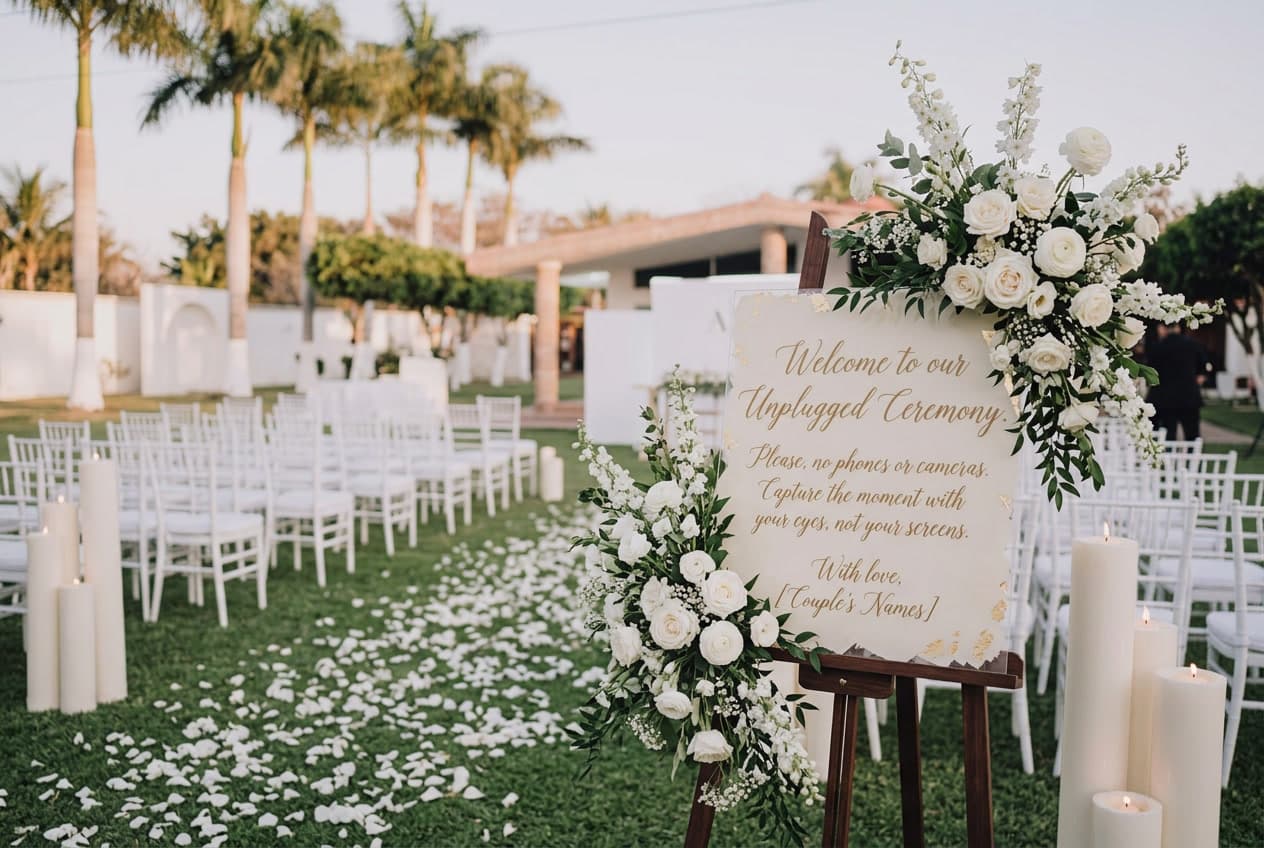
Most unplugged wedding signs fail for the same reason most diets fail: they're written as a prohibition. You're asking a room full of people who love you to sit perfectly still, hands empty, during the single most photogenic ten minutes of your life — and the only thing you've given them is the word "no."
The signs that actually work don't ban. They redirect. Phones down for the ceremony, phones up for the reception, and here's exactly where to send the photos. That one structural change is the difference between a sign guests glance at and a sign guests obey.
Below you'll find 15 unplugged wedding sign wordings you can copy straight onto an easel, organized by tone, plus where to place the sign and why one is never enough.
Why the timing of your sign matters more than the wording
A quick note before the wording, because it changes what you should write.
Looking at the weddings running on our platform, roughly 6 in 10 happen on a Saturday, with Friday a distant second at about 1 in 5 — around 85% of all events land on a Friday, Saturday, or Sunday. That clustering means your guests are almost certainly arriving from another commitment, in a hurry, checking their phone as they walk in.
They are not in a contemplative mood. They're in logistics mode. A sign written like a poem gets skimmed; a sign written like an instruction gets followed.
Seasonality matters too. April through June accounts for nearly half our annual event volume, with May the busiest single month, and November is a surprisingly strong off-season showing. Peak-season weddings mean bigger guest lists and more first-time attendees who genuinely don't know your preferences — which is exactly when explicit signage earns its keep.
The three-part formula behind every sign that works
Every effective unplugged ceremony sign does three jobs in order:
- Name the window. Not "our wedding" — "the ceremony," or "the next 25 minutes." An open-ended request feels like a rule. A bounded one feels like a favor.
- Give the reason. Guests comply when they understand they're solving a problem, not obeying a preference. "We hired a photographer" is a reason. "We'd prefer" is not.
- Offer the trade. Tell them when phones come back out and where the photos should go. This is the step almost every sign on the market skips, and it's the one that does the work.
Skip step three and you've written a ban. Include it and you've written a deal. People keep deals.
15 unplugged wedding sign wordings, by tone
Pick the tone that sounds like you saying it out loud. If you'd feel embarrassed reading it to your future mother-in-law, it's the wrong one.
Formal and traditional
Welcome to our unplugged ceremony. We ask that all phones and cameras remain put away until the recessional. Our photographer will capture the day; we would love for you to simply witness it.
The greatest gift you can give us today is your undivided presence. Kindly silence and stow all devices for the duration of the ceremony. Photographs resume — enthusiastically — at cocktail hour.
Please join us fully. Cameras and phones away for the next half hour, then back in your hands for the celebration that follows.
Warm and heartfelt
We've waited a long time to see your faces today — not the backs of your phones. Screens away for the ceremony. We'll trade you: every photo from tonight, shared with everyone.
Our photographer is here to capture how today looked. We're asking you to capture how it felt. Phones away until we're married.
You made time to be here. Let yourself actually be here. Devices down for the ceremony, up for the party.
The best seat in the house is the one you're already in. No screen required. Phones back on at cocktail hour — and we want every single photo you take.
Funny and irreverent
Unplugged ceremony. Translation: we paid a professional a truly upsetting amount of money, and your iPhone 14 is not helping.
Please put your phone away. We promise the ceremony is short, the open bar is close, and you may photograph absolutely everything after we kiss.
No phones during the ceremony. If you post before we do, we'll know. We will find you at the reception.
Your phone gets the next 8 hours. We're asking for 20 minutes. Seems fair.
Short and modern
Phones down. Hearts up. Ceremony only.
Be here now. Post later.
Unplugged ceremony. Fully plugged-in reception.
Religious and traditional-faith
Today we enter into a covenant before God and before you. We ask you to witness it with open hands and quiet phones. Devices away until the ceremony concludes.
Notice how many of these end with a forward-looking clause. That's deliberate. The sentence after the request is the one that gets you compliance.
Where to put the sign — and why one is never enough
A single sign at the aisle entrance is the most common setup and the least effective. Guests arriving in a cluster walk past it while talking to each other.
Use three touchpoints instead:
- The welcome table or ceremony entrance. Large, easel-mounted, unmissable. This is your primary sign.
- The program or seat card. One line at the top. Guests read programs while waiting — it's the only truly captive moment you get.
- The officiant. Thirty seconds before the processional, spoken aloud. Officiants widely recommend this as the single highest-compliance moment, and it costs nothing.
Signage alone gets partial compliance. Signage plus a spoken cue gets near-total compliance. If you only do one thing from this article, brief your officiant.
Designing the sign for 2026
Wedding signage this year has moved decisively toward what designers are calling utility-led signage — signs that solve an actual guest problem while still looking like part of the décor. The pure-decoration welcome sign is out; the sign that tells you something you needed to know is in.
A few practical rules:
- Typography over ornament. Heavy script at small sizes is unreadable from six feet away. Use a bold serif for the headline and a clean sans-serif for the instruction.
- Mind the mirror. Mirrored acrylic photographs beautifully and reads terribly in direct sun. Save it for indoor or shaded placements.
- One system, many signs. Your unplugged sign should share fonts and palette with your seating chart and bar menu. Cohesion is the dominant 2026 direction.
- Leave room at the bottom. You'll want space for the reception instruction — often a QR code.
The half of the sign nobody writes: where photos actually go
Here's the tension at the heart of every unplugged ceremony. You've just told 120 people not to take pictures. Those same people will take hundreds of pictures over the next six hours — during cocktail hour, at dinner, on the dance floor — and every one of them will end up stranded in a stranger's camera roll.
Which means the couple who most carefully controlled ceremony photography often ends up with the fewest guest photos overall. That's a bad trade.
The fix is to make the second half of your sign as specific as the first. Don't write "share your photos with us." Write where. A QR code at the bottom of the unplugged sign — and repeated on the bar and dinner tables — turns the restriction into a redirect: not don't photograph our wedding, but photograph the right part, and send it here.
That's the version guests actually respond to, because you've given them a job instead of a rule. We've covered the full setup in our guide to wedding QR code sign templates, and there's more on the etiquette side in our complete guide to the unplugged wedding ceremony.
It also helps to tell guests what to shoot. A little direction — the toasts, the grandparents, the dance floor at 11pm — produces dramatically better results than a generic request, which is the whole premise behind our wedding photography tips for guests and the prompt-driven approach in our wedding guest photo ideas.
Should you go unplugged at all?
An honest answer: for the ceremony, almost always yes. Aisle shots ruined by an outstretched arm are the most common regret photographers report, and it's unrecoverable — you cannot reshoot a first kiss.
For the reception, almost always no. An unplugged reception costs you the entire candid archive of your wedding in exchange for a vibe you could get by simply not looking at your own phone. The couples who get this right are strict for 25 minutes and generous for the remaining seven hours.
Get the sign made
You don't need to buy a $60 listing to get a good unplugged sign. Pick a wording above, pair it with a QR code so the reception half of the instruction actually goes somewhere, and print it.
We built free, customizable sign templates — including unplugged ceremony layouts with a built-in photo QR code → browse the free templates. If you want to see what guests get when they scan, take a look at how WeddingSnap works. There's no app for guests to download and no account for them to make — they scan, they upload, you keep every photo.
Frequently asked questions
How do you word an unplugged wedding sign?
Name the specific window (the ceremony, not the whole day), give a concrete reason (a professional photographer is covering it), and tell guests when phones come back out and where to send their photos. A wording that includes all three gets far higher compliance than a simple request to put phones away.
Where should the unplugged ceremony sign go?
Use three placements: a large easel sign at the ceremony entrance or welcome table, a one-line note at the top of the program, and a 30-second spoken reminder from your officiant before the processional. The spoken cue is the highest-compliance element and costs nothing.
Do guests actually respect unplugged wedding signs?
Mostly, when the request is bounded and explained. Compliance drops sharply when the sign reads as an open-ended ban on photography for the entire day, and rises when it clearly limits the restriction to the ceremony and tells guests they're encouraged to shoot the reception.
Should the reception be unplugged too?
We'd advise against it. Guest phones produce the candid reception photos your professional photographer will never catch, and an unplugged reception means losing that archive entirely. Restrict the ceremony, then actively invite photos afterward.
Can you put a QR code on an unplugged wedding sign?
Yes, and it's the most effective version of the sign. Placing a photo-upload QR code beneath the unplugged request reframes the message as a redirect rather than a prohibition — phones away now, photos welcome later, and here's exactly where to send them.