Courthouse Wedding Photos: Rules, Shot List and Real Costs
WeddingSnap Team
10/24/2026
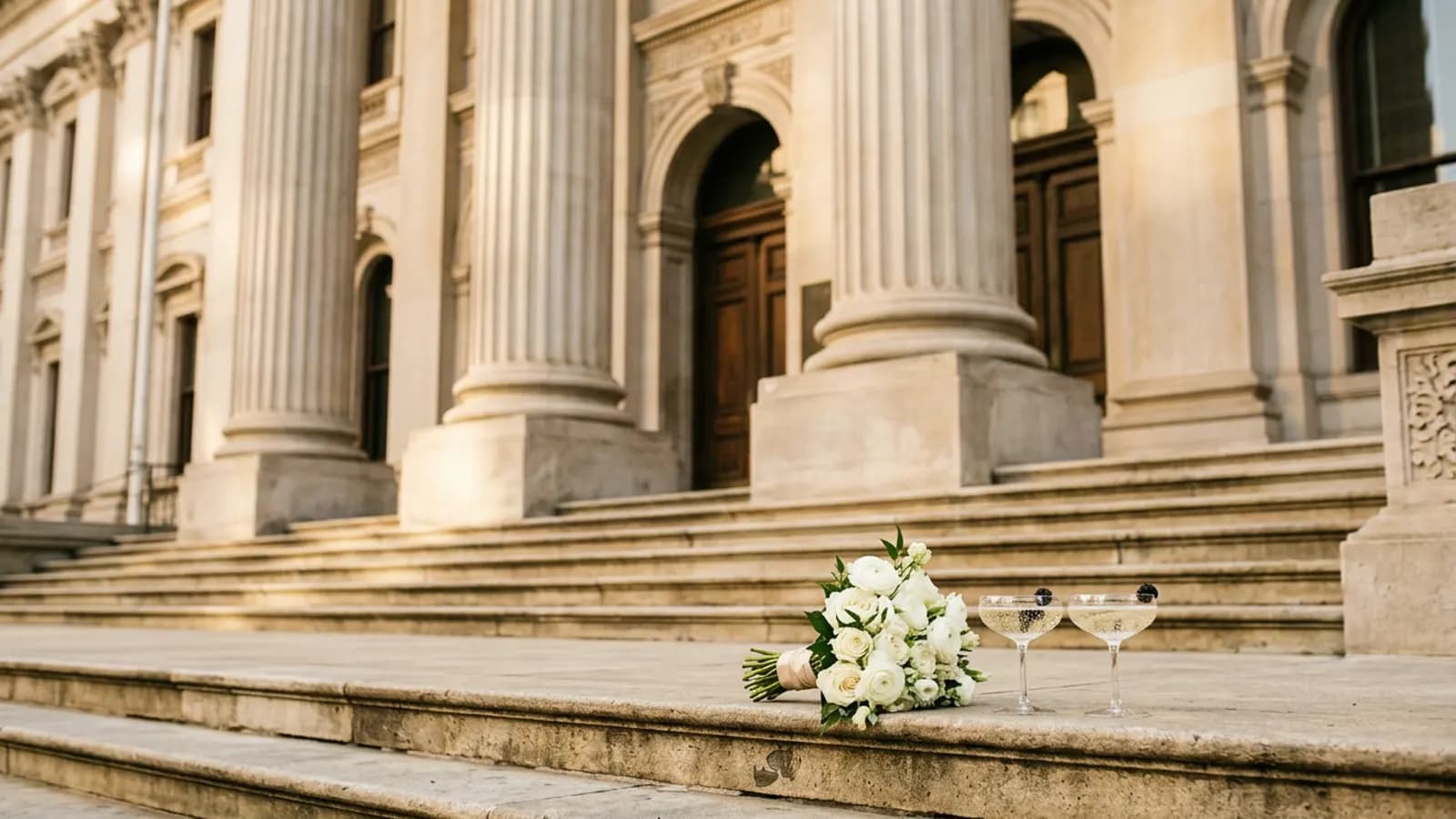
Most articles about courthouse wedding photos are galleries. They are lovely, and they skip the parts that decide whether your own photos turn out: whether a photographer is even allowed in the room, how few guests the clerk will let in, and the fact that the ceremony is over before most people have found the right camera setting. This guide covers those parts. Every courthouse rule below was read from the clerk's own page on October 24, 2026, and we say plainly where we could not confirm something.
Full disclosure: we make a guest photo-sharing app. For a courthouse wedding with four guests, you probably do not need it, and we explain why below.
The short answer
- Check the clerk's photography rules first. They vary a lot. San Francisco City Hall limits in-person ceremonies to six guests or fewer. Several Cook County courthouses only allow photos inside the ceremony room.
- Plan for a ceremony that lasts minutes, not an hour. Your photos happen before and after it, mostly outside the building.
- A short session is the sweet spot. Named photographers list one-hour courthouse or City Hall coverage from about $200 to $1,000. A full-day wedding photographer averages several thousand dollars.
- The steps outside are your real venue. Most of the photos couples love are taken on the front steps, in the hallway, and on the walk to lunch.
- Give your guests a job. With so few people present, one friend assigned to candids and video is worth more than five people filming by accident.
- Collect the photos the same day. A shared album is fine for a small group. A gallery helps when there is a dinner or party afterwards, or family watching from far away.
Courthouse photography rules: what the clerks actually say
Each county runs its own building, and there is no national standard. Here is what we found on four official sites. Use it as a sense of how different the rules can be, then check your own clerk.
| Location | Guests | Photography | Booking |
|---|---|---|---|
| San Francisco City Hall | 6 or fewer for a standard in-person ceremony | Clerk's photographer rules: one photographer per couple, no flash, no large pro gear (see note below) | Reservation required, no walk-ins, arrive 15 minutes early |
| Cook County, Skokie (2nd District) | Up to 15 | Photos only in the room where the ceremony is performed | Mon–Fri, check in by 2:30 p.m. |
| Cook County, Bridgeview and Markham | Not stated | Photos only in the ceremony courtroom. No video cameras. | Weekday afternoons |
| Cook County, downtown Chicago Marriage Court | Not stated | Not stated | Tue–Fri 9–12 and 2–4. Saturday mornings by appointment. $10 fee. |
| NYC Marriage Bureau | Not stated on the clerk's pages | Not stated | In-person appointments only, booked through Project Cupid |
Rules checked on each clerk's own website, October 24, 2026. The San Francisco photographer rules come from the County Clerk's "Rules for Photographers" page. That page would not load for us on the check date, so treat those details as likely but not confirmed.
Two things stand out. Video is the rule most likely to catch you out. Two Cook County courthouses ban video cameras outright, and the San Francisco photographer rules restrict video in some clerk rooms. If a phone recording of your vows matters to you, ask about it when you book.
The second is that a photographer usually counts as a guest. Where the cap is six, a photographer and a witness leave room for four people. Decide early whether that slot goes to a professional or to your mom.
Your courthouse photo timeline
Most civil ceremonies run on fixed weekday slots. That alone makes a courthouse wedding unusual. On our platform, more than six in ten weddings happen on a Saturday, and Monday-to-Thursday events add up to roughly one in nine. A Tuesday-at-2 p.m. wedding has its own light and its own crowds, so plan around them.
- 45 minutes before. Getting-ready details at home or the hotel: the outfit on a hanger, the rings, the license, the flowers. A phone does this well.
- 20 minutes before. Arrive, check in, and take your first portraits on the steps while you wait. This is often the calmest time you will have.
- The ceremony. It is usually over in a few minutes. Your photographer, or one assigned friend, stays on your faces, not the officiant.
- Right after. Signing the license, the first kiss as a married couple in the hallway, and a group photo with everyone who came.
- The next 30 to 60 minutes. Portraits outside, the walk down the street, and the confetti or flower toss on the steps if the building allows it.
- Lunch or dinner. The part people forget to photograph. It is often where the funniest pictures happen.
This is why one-hour photo packages exist. The ceremony is the shortest part of the day, so you are paying for the time around it.
Where to shoot: inside vs. the steps outside
Inside, the light is the problem. Clerk offices are often lit by overhead fluorescents, which make skin look green and flat. Many rooms also forbid flash. If you are shooting inside, put the couple near a window, turn off the phone's flash, and let the phone's night mode take care of the rest. Hallways in older city halls, with their marble, columns and long staircases, are worth five minutes. Just stay off the stairs if the building says so. San Francisco's rules specifically ban posing on stairwells, doors and hallways in a way that blocks them.
Outside, you control everything. Courthouse steps face the street, so the light depends on the time of day. A morning or late-afternoon slot gives you softer light than noon. If you are stuck with midday sun, move the couple into the shade of the building and shoot towards the brighter street.
The 2026 look is direct flash outside. The Knot lists "the courthouse moment" among its 2026 trends, and the photos people save tend to look like a paparazzi shot or a disposable camera: hard flash, deep shadows, the couple mid-laugh on the steps. You can't use flash indoors at many courthouses, but outside you can. Use your phone's flash on purpose, or hand a friend a point-and-shoot.
The courthouse wedding shot list
Keep it short. A small wedding makes a long shot list feel like homework.
- The license and the rings together, before you leave
- The outfit details: shoes, bouquet, a hat or veil if there is one
- Walking up to the building, from behind
- The couple with the courthouse name or facade in the frame
- Waiting in the hallway: nervous, bored, holding hands
- The vows, framed tight on both faces
- The first kiss
- Signing the license, and the officiant's hand passing it over
- Every guest, in one group photo, before anyone leaves
- The witness with the couple (they are part of the legal record, so give them a photo)
- The exit on the steps, with confetti or petals if allowed
- A slow walk down the street, shot from across the road
- The first drink, the first bite, and the toast at lunch
For more prompts to give your guests, our wedding guest photo ideas list works just as well for a courthouse wedding as for a reception.
Do you need a photographer for a courthouse wedding?
Probably not for a whole day, but often for an hour. The listed prices we found on photographers' own pages, October 24, 2026:
- A New York City photographer on Airbnb offers a 45-minute post-ceremony session at $450, a one-hour City Hall session at $550 with 80+ edited images, and two hours at $900.
- A photographer in Clifton Springs, NY, listed on Zola, prices a one-hour package at $200–$800 off-peak and $800–$1,000 peak.
Compare that with full wedding coverage, which runs into the thousands. We cover that in how much a wedding photographer costs in 2026. If even an hour is out of budget, our guide to alternatives to a wedding photographer explains what friends and phones can realistically cover.
Our honest view: if the ceremony itself matters most to you, hire someone for an hour. Your friends will be crying or filming, not both, and the ceremony is short enough that one missed angle means no photo at all. If the party afterwards matters more, spend the money on that.
Getting good photos from your guests
With four or six people in the room, every guest counts. A few things help:
- Assign one person to candids and one to video. Tell them before the day. People who know it is their job stand in better places.
- Ask for horizontal video of the vows and vertical clips of everything else. Horizontal is better for watching on a TV, and vertical is better for posting.
- Tell them about the room rules in advance. No one wants to get told off by a court officer mid-ceremony.
- Turn off phone flash indoors. It flattens faces and, in some buildings, isn't allowed.
Our wedding photography tips for guests post is short enough to text to your witness the night before.
Collecting the photos afterwards
Here is where we will be honest about our own product. If six people came and nobody else is waiting to see the photos, a free shared album is enough. Make a Google Photos or iCloud shared album, send the link in the group chat, and you are done. Our comparison of Google Photos, Apple Shared Albums and wedding galleries covers the catches, mainly what happens when some guests have iPhones and others have Android phones.
A gallery is worth it in two cases:
- There is a dinner or party afterwards. Many courthouse couples follow the ceremony with a restaurant dinner or a backyard reception weeks later. That is 30 or 60 people taking photos, and most of them will not be in your group chat.
- Family is watching from far away. Grandparents who could not fit under the guest cap can see the photos on the day without downloading an app or creating an account.
WeddingSnap is a one-time $39.99 payment. Guests scan a QR code and upload straight from their camera, with no app and no login. Photos and videos are stored at full resolution, and there is a live slideshow for the party. One QR code works from setup until a year later, so it covers both the courthouse and the celebration afterwards.
Having a party after the courthouse?
One QR code collects every guest's photos and videos at full resolution, with no app for guests. $39.99 once, no subscription. Print a sign from our free QR sign templates or try the live demo first.
FAQ
Can you take pictures at a courthouse wedding?
Usually yes, but the rules vary by building. Several Cook County courthouses allow photos only inside the ceremony room, and two of them ban video cameras. San Francisco's clerk allows one photographer per couple and bans flash. Check your clerk's website when you book.
How many guests can you bring to a courthouse wedding?
It depends on the county. San Francisco City Hall allows six or fewer for a standard in-person ceremony. Cook County's Skokie courthouse allows up to 15. Many clerks do not publish a number, so ask. A photographer often counts towards the limit.
How much does a courthouse wedding photographer cost?
One-hour courthouse packages we found on photographers' own pages range from about $200 to $1,000, depending on city and season. A New York City listing charges $550 for one hour with 80+ edited images.
What should I wear for courthouse wedding photos?
Something that photographs well in flat indoor light and harsh outdoor sun. Solid colors and texture, like satin, linen or a structured suit, usually look better than busy prints. Bring flat shoes for the walk between locations.
What is the best time of day for courthouse wedding photos?
An early morning or late afternoon slot gives softer light on the steps outside. If you can only get a midday slot, shoot in the building's shade or use flash on purpose for the 2026 editorial look.
Sources
- San Francisco — Have a civil marriage ceremony at City Hall: six or fewer guests, reservation required, no walk-ins. Read October 24, 2026.
- San Francisco County Clerk — Rules for Photographers in the Office of the County Clerk and City Hall. The page did not load on the check date. Details are from its published summary.
- Circuit Court of Cook County — Marriage and Civil Union: ceremony times, guest limits and photography rules by district. Read October 24, 2026.
- Office of the City Clerk, New York City — Getting Married: in-person appointments only, no walk-ins. Read October 24, 2026.
- NYC City Hall photography sessions on Airbnb and MJ Photo Co on Zola: listed package prices. Read October 24, 2026.
- The Knot — New Wedding Trends: "the courthouse moment" as a 2026 trend.
- WeddingSnap pricing: $39.99 one-time, verified October 24, 2026.
Related reading: wedding guest photo ideas, engagement photo ideas, and how to set up a shared wedding album.