Best Camcorder for a Wedding: What to Look For (Buy or Rent?)
WeddingSnap Team
11/24/2026
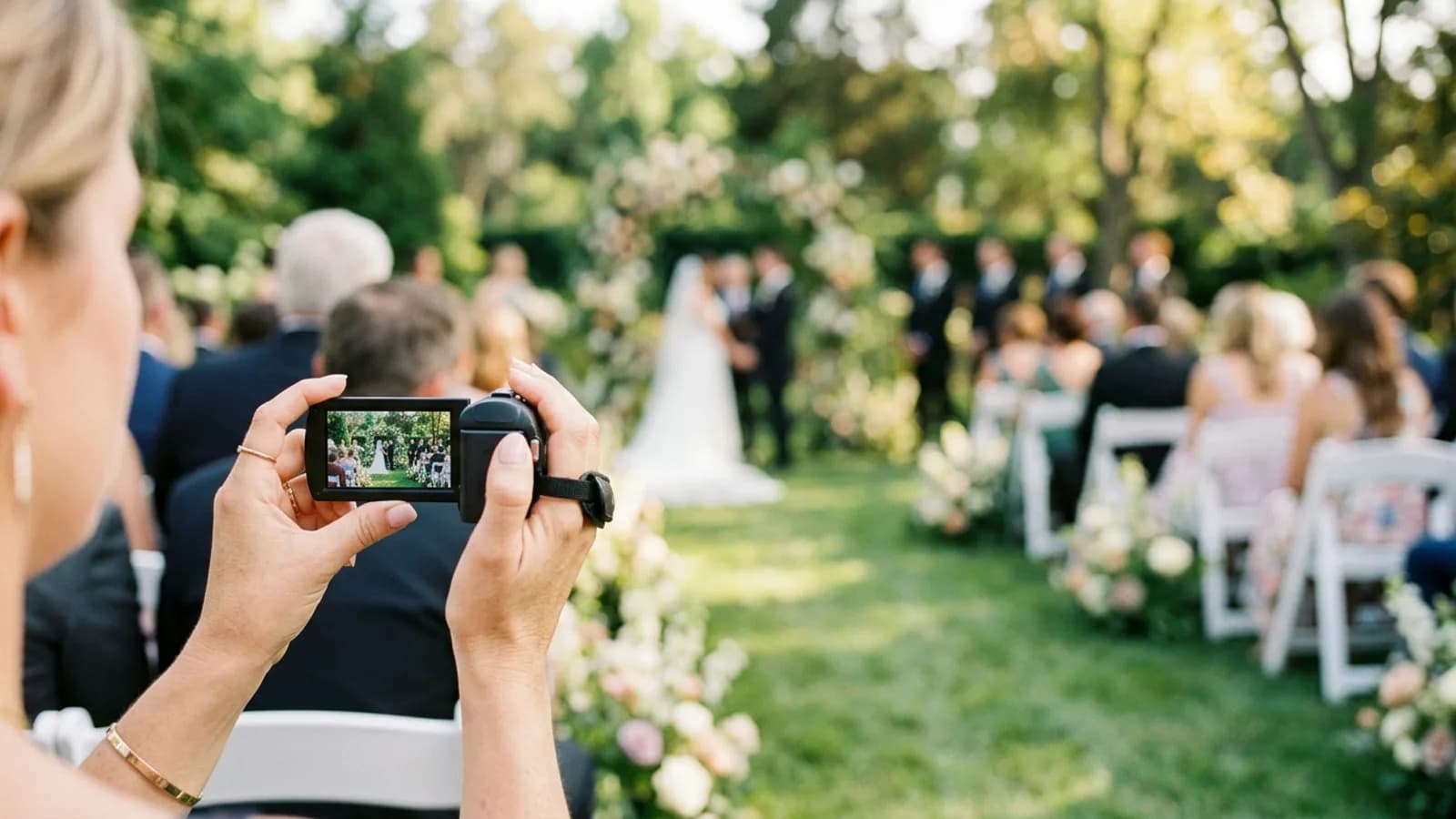
Search for the best camcorder for a wedding and you get Reddit threads about models from 2013 and listicles of cameras for professional videographers. Neither helps if you plan to hand a camera to your guests. So this guide skips models, which change every year, and covers the specs that make guest footage watchable, what tapes really cost, and whether to buy, borrow or rent. Prices were checked on November 24, 2026, with sources at the end.
The short answer
- 20x optical zoom or more, so the back row can still fill the frame with two faces.
- A bright lens, around f/2 or lower, because receptions are dark.
- Strong stabilization, because nobody holding a drink holds a camera still.
- Batteries for the whole night, planned on the spec sheet's "typical" time, not the headline number.
- A 128 GB or 256 GB V30 card. At most consumer 4K settings, that covers a wedding.
- A flip screen and one obvious record button.
Why a dedicated camera at all?
Guests already carry good cameras. They just do not film much: on our platform, about 93% of guest uploads are photos and only about 7% video. A camcorder changes the behavior, not the image quality. Whoever holds the one shared camera knows filming is their job for the next ten minutes. That is the point of the guest camcorder trend.
The specs that actually matter when guests are filming
1. Optical zoom, not digital
Guests film the ceremony from their seats. Optical zoom gets closer with no loss of quality. Digital zoom crops and enlarges, and looks soft on a TV.
The math: a 20x camcorder lens reaches roughly the equivalent of a 600mm telephoto. From 60 feet back, that frame is about 3.6 feet wide, which is two people from the waist up. Past a phone's built-in telephoto lens, its zoom is digital.
2. Low light and aperture
Receptions are dim on purpose. Check the lens aperture, written as f/ and a number. Lower means more light: an f/1.8 lens lets in about 2.4 times as much light as an f/2.8 lens, which is the difference between clean and grainy. Check both ends of the zoom, too. One 4K camcorder we looked at on a rental site is f/2.8 at its widest and f/4.5 fully zoomed, so the ceremony close-up gets darker exactly when you need it.
3. Stabilization
It matters most zoomed in, where a small tremor becomes a big wobble. Look for optical or multi-axis ("5-axis") stabilization, and tell guests to brace an elbow on a chair back during the vows.
4. Battery life in real hours
Spec sheets give two numbers. Continuous time assumes you press record once and walk away. Typical time assumes real use: start, stop, zoom, repeat. Guests film in bursts, so plan on typical. The gap is big: one manufacturer's help guide for a consumer 4K camcorder lists its supplied battery at 135 minutes continuous but 65 minutes typical in 4K, and warns that cold shortens it. A ceremony plus a five-hour reception needs about three batteries, or a charger guests can find.
5. Storage per hour of 4K
File size depends on bitrate, not the "4K" label. Consumer 4K camcorders commonly record around 60 Mbps, 100 Mbps is the standard 4K setting on many mirrorless and action cameras, and phones record 4K at roughly 35 to 75 Mbps. The formula: Mbps × 0.45 = GB per hour.
| Bitrate | Per hour | 128 GB card | 256 GB card |
|---|---|---|---|
| 50 Mbps | about 22.5 GB | about 5 hr 40 min | about 11 hr |
| 60 Mbps | about 27 GB | about 4 hr 45 min | about 9 hr 30 min |
| 100 Mbps | about 45 GB | about 2 hr 50 min | about 5 hr 40 min |
Calculated as Mbps × 3,600 seconds ÷ 8 ÷ 1,000. Real cards hold slightly less after formatting.
Guests rarely film more than two or three hours in total, so 128 GB is usually enough at 60 Mbps and 256 GB is safe at 100 Mbps. Buy a V30 card, the SD Association's video speed class for 4K. At 100 Mbps the camera only writes about 12.5 MB per second, so pricier, faster cards add nothing.
6. Audio for toasts
A built-in mic records whatever is closest. For toasts that is usually fine, since the speaker is on a microphone and the PA is loud. The problem is the guest at a back table, who records the toast plus their whole table talking. An external mic rarely matters for guest filming. Two cheaper fixes work better: have whoever films the toasts stand near the PA, and ask your DJ or band to record the microphone feed to line up with the video later. For spoken messages from guests, use a wedding audio guest book instead.
7. A flip-out screen
A forward-facing screen lets guests film a message to the couple and see they are in the frame.
8. Simplicity
Your least technical uncle should be able to use it without asking: one big record button, full auto, settings that stay put.
What doesn't matter
- Manual controls. Guests will only touch them by accident.
- 8K and high frame rates. Bigger files, shorter battery life, no visible benefit on a TV.
- RAW, 10-bit and log profiles. Made for professional color grading, not guest footage.
- Interchangeable lenses, Wi-Fi apps, projectors. Irrelevant at a reception.
Phone vs. camcorder, honestly
In daylight, a recent phone shoots 4K as good as many consumer camcorders, at a similar bitrate. If your video budget is zero, ask two friends to film the ceremony and toasts on their phones and collect everything in one place. That is a perfectly good plan.
The camcorder wins in four places: optical zoom for the ceremony, a battery that belongs to the camera so nobody stops filming to save their phone, no notifications halfway through the first dance, and one place for the footage instead of clips scattered across 100 phones. It also films horizontally by default, which is what you want on a TV.
Vintage tape camcorders: MiniDV, Hi8 and VHS-C
The tape look comes from the format: standard definition, a 4:3 frame and tape texture.
- VHS-C. Analog compact VHS. A standard tape holds about 30 minutes at normal speed, or 90 at the lowest-quality speed. The most "home video" look and the shortest tapes.
- Hi8. Analog 8mm tape, sharper than VHS, about two hours per tape. You usually need the camera itself to play tapes back.
- MiniDV. Digital tape at 720×480, about 60 to 90 minutes per tape. The cleanest of the three, so the least "vintage" looking.
The costs the listing will not mention:
- The camera is the cheap part. In the eBay listings we checked, working VHS-C cameras sold for roughly $20 to $85 and tested Hi8 cameras for about $95 to $180. MiniDV asking prices ran about $100 to $400.
- "Untested" usually means broken, and old batteries rarely hold a charge.
- Tapes are running out. A major electronics maker ended production of its MiniDV cassettes in February 2025, with no successor.
- Digitizing is per tape. One national transfer service charges $19.99 per tape for standard definition and quotes two to three weeks. Five hours on 30-minute VHS-C tapes is ten tapes, about $200, before anyone edits a second.
If you love the look, price it as camera plus tapes plus transfer. We compare the options, including digital cameras that record a retro look to a memory card, in our guides to the 90s wedding video look and Super 8 wedding video.
Buy, borrow or rent: what it really costs
| Option | Camera cost | Also budget for | Who edits |
|---|---|---|---|
| Borrow a camcorder, or use phones | $0 | A card, a spare battery, a thank-you gift | You |
| Buy new 4K camcorder | About $200–$300 for budget pocket models; about $1,450 for an established-brand model | Card, spare batteries | You |
| Buy vintage tape camcorder | About $20–$400, by format and condition | Tapes, batteries, about $20–$40 per tape to digitize | You |
| Rent from a camera rental site | From $103 for 3 days; $145–$187 for a week | Shipping, optional damage coverage, card | You |
| Rent a wedding camcorder kit | About $345 camera-only; about $650–$1,700 with an edit | Usually included: shipping, card, batteries | Their editor, if included |
Prices as listed November 24, 2026. New prices from Target's 4K camcorder category. Rental rates are professional 4K camcorders at Lensrentals. Vintage prices are eBay listings, not a market survey. Wedding kit prices are from rental companies' own pages; we compare them in our Wedding Weekender review.
General rental sites stock professional camcorders: more buttons, heavier bodies, no how-to card. Great for a friend who shoots video, a lot to hand to a table of cousins.
The cost nobody budgets: the edit
Hours of guest footage is mostly people walking and blurry dance floors. The good 30 seconds are in there, but someone has to find them. One wedding editing studio says a professional five-minute highlight film can take 30 to 50 hours to edit. If you pay a freelancer, PayScale puts the median freelance video editor at about $20 an hour, so 30 hours is about $600. Outsourcing studios advertise highlight edits from $35 to $80, but those prices assume a professional videographer's organized footage, not a card full of guest clips.
A $300 camera plus 40 hours of your time is not a $300 video. If someone in the family loves editing and will actually finish, buying or borrowing is great value. If not, the footage tends to stay on the card. Our post on videographer cost vs. a camcorder kit covers when a professional is the better spend.
Set it up for guests: the checklist
- Charge every battery the night before, and pack the charger.
- Format the card in the camera, not on a computer.
- Set the date and time so clips sort in order later.
- Pick one recording setting (4K at 30p is fine) and leave it.
- Do a 30-second test in your dimmest room and play it back.
- Tape a how-to card to the camera: "Red button to start and stop. Hold it sideways. Film 10 seconds, then pass it on."
- Add a wrist strap.
- Name a camera captain to check the battery each hour.
- Write your phone number on the camera in case it goes home with someone.
For who should hold the camera and a shot list to give them, see how to run the guest camcorder on the day.
Or rent one with the edit included
Full disclosure: we run a wedding camcorder rental, so read this section as our pitch.
We built it around the specs above, and you pick one camera type per booking. The 4K camcorder has a 24x optical zoom for the ceremony from the back, a bright f/1.8 lens for dim receptions, 5-axis stabilization and a flip-out screen. The vintage-look Super 8-style camera gives warm, grainy footage like a 70s home movie, with five built-in film looks, an 8x zoom and no screen: point and pull the trigger. It records to a memory card, so there is no film to buy or develop.
It arrives three to four days before the wedding with a card, chargers, a how-to card for guests and a prepaid return label. Our editors cut a 4–6 minute film (6–8 minutes with two cameras) from the camera footage and your guests' phone footage, with one round of changes and every second of raw footage to download. More in our guide to wedding camcorder rental.
Skip the 40 hours of editing.
Our camcorder rental with an edited film includes the camera, shipping both ways within the US, a film within 4 weeks of the kit coming back, 3 vertical edited videos in 2–7 days, and a QR gallery for your guests' phone footage. $699 for one camera, $949 for two. Book at least 7 days before the wedding.
FAQ
What is the best camcorder for a wedding?
For guests: at least 20x optical zoom, a bright lens around f/1.8 to f/2, strong stabilization, a flip-out screen, one obvious record button and enough battery for the night. Skip 8K and manual controls. Any current consumer 4K camcorder with those specs will do.
Is it better to buy or rent a camcorder for a wedding?
Rent if you will use it once. A week from a camera rental site costs about $145 to $187, while a new established-brand 4K camcorder can cost about $1,450. Either way, budget for the edit.
How much storage do I need to film a wedding in 4K?
Multiply the bitrate in Mbps by 0.45 to get GB per hour. At 60 Mbps, a 128 GB card holds about 4 hours 45 minutes. At 100 Mbps, a 256 GB card holds about 5 hours 40 minutes. Use a V30 card.
How long does a camcorder battery last at a wedding?
Plan on the spec sheet's "typical" recording time. One consumer 4K camcorder lists 135 minutes continuous but 65 minutes typical on its supplied battery. For a ceremony and five-hour reception, bring about three batteries or a charger.
Sources
- Have Camera Will Travel — 4K video storage capacity: GB-per-hour formula, 100 Mbps standard 4K, phone bitrates of 35–75 Mbps, V30 enough for 100 Mbps. Read November 24, 2026.
- SD Association — Speed Class: Video Speed Class ratings for 4K recording.
- Lensrentals — video rentals: 4K camcorder rates, lens range and aperture specs. Read November 24, 2026.
- Target — 4K camcorders: listed prices from about $200 to $1,455. Read November 24, 2026.
- Capture — MiniDV to digital: $19.99 per tape (SD) to $39.99 (4K), 2–3 week processing. Read November 24, 2026.
- Wikipedia — VHS-C, 8 mm video format and DV: tape formats, lengths and resolution.
- Fotober — wedding video editing pricing (February 2026): 30–50 hours for a professional 5-minute highlight; packages from $35–$80.
- PayScale — freelance video editor hourly rate: $20 median (updated September 2026, small sample).
- Battery figures: a camera manufacturer's online help guide for a consumer 4K camcorder, 4K at 60 Mbps. Read November 24, 2026.
- MiniDV cassettes: a manufacturer's end-of-production notice, reported by trade press January 28, 2025.
- Vintage camcorder prices: eBay sold and listed VHS-C, Hi8 and MiniDV camcorders, November 2026.